
 FORGIATO WHEELS
 ARTIS WHEELS
 AMANI FORGED WHEELS
 4PLAY WHEELS
 DEFIANT WHEELS
 OE WHEELS REPLICA
 OEM WHEELS
 WHEEL SETS
 WHEEL SINGLES
 WHEEL TIRE SETS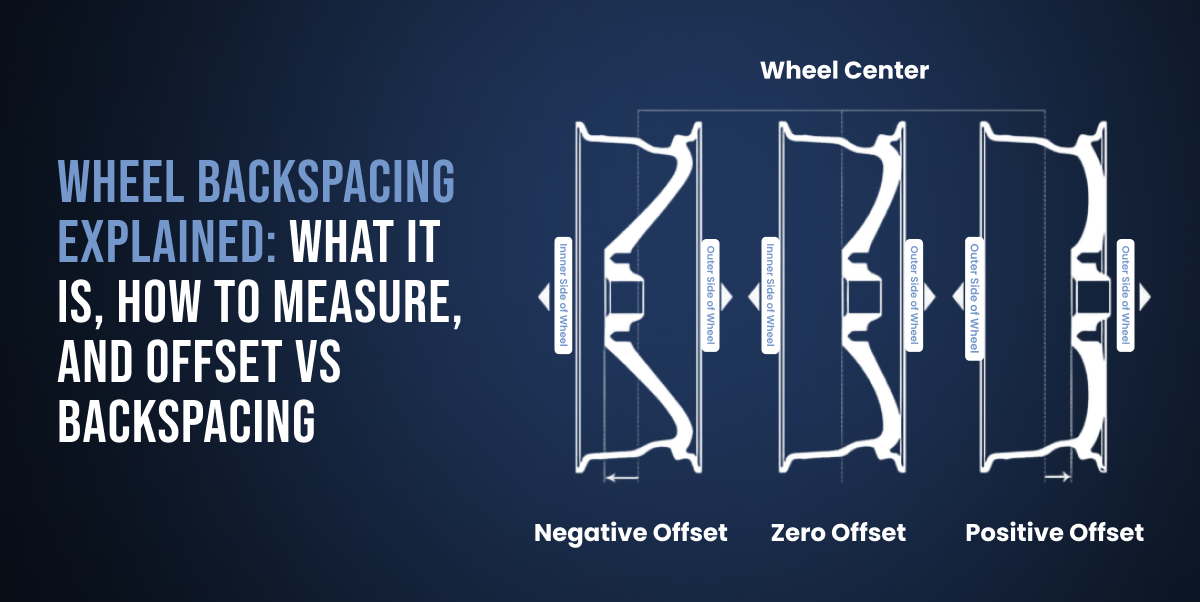
In this guide, you’ll understand wheel backspacing, how to measure it, how it compares to offset, and how it affects fitment, tire choice, and driving feel, without the jargon.
Jump to: At a Glance • Definition • Fitment & Driving • Backspacing vs Offset • Measure • Find OEM Specs • Convert • Spacers • Checklist • Conclusion • FAQs
Wheel Backspacing At a Glance
Definition: Wheel backspacing is the distance from the wheel’s mounting pad to the inside rim edge, measured in inches. More = further in, less = further out.
Three quick steps: Wheel face-down → straightedge across inside rim → measure straight down to mounting pad.
Need the math? See the formulas in Convert.
What Is Wheel Backspacing?
Backspacing is the distance in inches from the wheel’s mounting pad to the inside rim edge. Picture a bookshelf: the front edge is the mounting pad, the back wall is the inside rim edge, and the book is your wheel. Backspacing is how far you slide the book toward the back wall.
Slide it deeper (more backspacing), and the wheel sits closer to the brake caliper, strut, and spring perch, so check that nothing rubs. Pull it out a little (less backspacing) and you gain inner room, but the wheel moves outward, so check the fender and fender liner.
Use backspacing to predict inner clearance before you buy quickly.
Why the checks matter:
● Inside (brakes and suspension): If the tire or wheel touches the caliper, strut, or spring perch, it can cut the tire sidewall, gouge the wheel, overheat or damage brake parts, shred ABS sensor wiring, and cause vibration or sudden air loss.
● Outside (fender and liner): If the tire hits the fender lip or plastic liner, it can slice the tire shoulder, crack or bend body parts, melt the liner, and rub badly on turns or big bumps.
To stay safe, aim for a clear, visible gap on both sides and recheck at full steering lock and with the car compressed over a bump. If space looks tight, choose a setup with a touch less inboard or outboard movement.
How Backspacing Affects Wheel Fitment, Clearance & Driving Feel
Inner clearance (brakes/struts/springs)
More backspacing pushes the wheel inward. If the gap gets too small:
● Safety & wear: The tire sidewall or wheel can rub the caliper/strut/spring perch, cutting the sidewall, scuffing the wheel, and overheating brake parts.
● Driving feel: You may hear scraping, feel vibration, or smell rubber after turns/bumps.
● Fix: Choose slightly less backspacing (or a lower positive offset) or use a small hub-centric spacer, then recheck that a clear, visible gap remains.
Outer clearance (fenders/liners)
Less backspacing pushes the wheel outward. If the gap gets too small:
● Body/tire damage: The tire can hit the fender lip or plastic liner on bumps or at full steering lock, slicing shoulders and chipping paint or cracking liners.
● Driving feel: Expect heavier steering/kickback on rough roads if wheels sit far out; extreme “poke” can also increase tramlining.
● Named for the way a tram follows its tracks, tramlining describes the sensation of your car being involuntarily ‘guided’ by road grooves, causing the steering wheel to pull or wander to the left or right in your hands.
● Fix: Keep a visible gap, verify clearance at full lock and over bumps, and adjust with a touch more backspacing (higher offset) or slightly narrower wheel/tire if needed.

No comment